



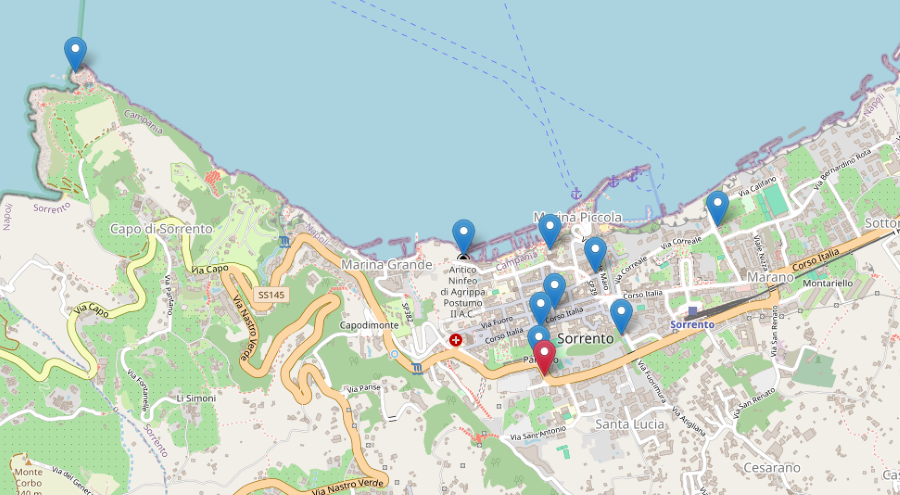
The city of Sorrento preserves a widely distributed archaeological heritage, visible through numerous sites and monuments that bear witness to its long and ancient history. The map accompanying this itinerary brings together the main places connected with archaeology, spread throughout the urban fabric and the surrounding territory.
Among these, particular attention is drawn to the Roman mausoleum on Via degli Aranci, the focus of recent study and enhancement projects. In Piazza Veniero, the remains of a Roman villa can be seen, while Porta Parsano preserves traces of the viceregal walls and of a gate dating back to the pre-Roman period.
Also of special interest are the nymphaea of the villa of Agrippa Postumus, associated with a residence of great prestige, and Porta Marina, the ancient maritime gateway to the city. On the promontory stands the Roman villa at Capo di Sorrento, one of the most evocative archaeological complexes in the area.
The archaeological route also includes the Archaeological Section of the Museo Correale, with its adjoining cistern, the Cisternoni Spasiano, the Roman mausoleum of Sottomonte, and ancient hydraulic infrastructures, such as the Neffola Aqueduct.
Other Roman remains are visible near the Hotel Lorelei, close to the Farmacia Canale, and along Via San Paolo, where the remains of the Roman theatre are preserved.
Taken together, these sites make it possible to reconstruct the urban development of Sorrento and to appreciate the richness of its archaeological landscape, which is still today deeply intertwined with the modern city.
experience the best of the Sorrento Peninsula